Tuesday, March 27, 2007

The Newspaper Lament

I had a comment (which I HUGELY appreciate) suggesting I read a column and rebuttal by David Lazarus that appeared the San Francisco Chronicle to get a feeling for how people in the industry feel about the same kind of things I’ve been saying about their industry.

I think the author is feeling a little depressed about the kind of things that people said and rightly so. I would have been devastated by the things the clueless idiots were saying. But he is still wrong.

But these articles say it’s really all about paper and the business model that has grown up around it. It’s absolutely fascinating reading, especially by us online types that have created large web sites.

Here are some of the most relevant quotes:

"The main point of my earlier column was that newspaper content has value. Once you acknowledge that, you have to acknowledge that newspaper Web sites are giving away something valuable in exchange for ... what? "


I acknowledge that. I'm a huge fan, especially of reporters and editors. If my life had run a little bit differently it might have been a journalism major in college. My browser’s home page is the Seattle Times, so I generally read it several times a day. I acknowledge my local paper as THE best site for quality local content. I acknowledge the sacred trust you hold in your hands and understand that this must be a heavy burden to bear for a lifetime.

But I don't agree with the rest of this statement, but let me rebut it in a second.

“The harsh reality, though, is that most newspaper Web sites account for only about 5 percent of total revenue. That means a news organization that relies primarily on the Internet couldn't possibly support a newsroom as large or resourceful as what the paid-for print product allows.”


Two points here:

1 – This is a self fulfilling point. The companies that make their money from publishing on dead trees make their money by publishing on dead trees. The delivery method doesn’t make a difference to the content or the quality of the content (Layout yes, functionality yes, content no.) And the Seattle Times costs around fifty cents a day. I doubt that with all the costs from pringing and deliver they make much money off of this, but rather the advertising that goes onto the pulp.

2 - Another harsh reality; just because YOUR online revenue is 5%, it does not follow that:

a) it has to stay that low


b) YOU couldn’t be replaced by a different news site who does as good a job delivering high quality content. Somebody else could hire reporters and have a sustainable online profit margin with free content. Imagine a newspaper where everybody works from home, with no printing costs and hence no printing office space. I’m not saying that this is what I want, but their bottom line would be substantially lower with out a drop in the quality of the content. After all, this is the model that “foreign correspondents” used to create their great content and they have broken many an important story.


Compare the amount and quality of the online advertising on the Seattle Times and an offbeat local newspaper called The Stranger. I bet the Stranger makes more that 5% of its revenue from online advertising. (But I don’t know for sure.).

“And that means this glorious new paradigm of content that's not worth paying for would allow news organizations to be capable of doing only a fraction of the investigative and watchdog work they currently perform.

The stakes couldn't be higher -- that is, unless bloggers and cyberreaders are satisfied to accept the words of Washington politicians, or companies like Halliburton and Enron, at face value.”


Again, you are right.

And I’m very sad about it. Especially when we are talking about the old quasi-National pages that are in very deep trouble now. They were the ones with the deep pockets and super contacts to really protect the world. But the sacred trust that professional journalist have isn’t going to go away no matter if it’s pulp or bits. And news companies are just going to have to find new ways to accomplish this if they want to stay competitive.

I also reject your assumption that online newspapers will never make enough money to support a large staff. So you make 95% of your profit on the pulp side now. It doesn’t mean that there isn’t another 95% to make from the online side. Maybe you will be able to do more. Maybe the disaster that was the build up to the Iraq war would never be able to happen in the new world.

Perhaps newspapers will need to join together to investigate and break big stories. Maybe a reporter working for the Seattle Times could partner with somebody from the SF Chronicle and NY Times to expose a scandal. This could create an army of smaller newspapers who currently don’t have the resources to play on the big stage. Maybe they could even partner with the best of bloggers. Maybe instead of two reporters breaking Watergate, it could have been 6 and they could have ferreted out the details in half the time.

On a side note, I do agree with you about 99% of the bloggers out there. They are like eager puppies that really don’t have a clue about “real” reporting. But that doesn’t mean that you couldn’t train them or find some other clever ways to use them. That’s what Editors are for, isn’t it? A lot of reporting is dull drudge work, if you could offload some of this from your reporters or rely less on wire services; the quality of news could go up, not down.

Rather than lamenting that the Internet was invented, newspaper companies need to be asking themselves how they can take advantage of it.


"… I suggested in my earlier column that another, albeit temporary, remedy may lie in seeking an exemption to antitrust laws so that newspapers as an industry can unite in charging for some or all online content."

You go to antitrust laws for your answer? That’s your answer to this huge opportunity? Not to join the 21st century and innovate but instead to have the government protect your right to carry on like you used to? And even if you get the government to protect you, it doesn’t take a newspaper company to put quality news on the internet. MSNBC – a web site with no newspaper has over 3 million visitors a day and doesn’t charge for content. TV stations are putting more and more local content on their web sites and have unparalleled free advertisements. If the newspaper industry creates a vacuum for free, quality, local content, somebody else will just fill it.

It will always be about quality content no matter if it’s delivered on pulp, bits or both. The business model and monetization for the online segment must change. The online experience for the Seattle Times is not as high quality as the print version and I resent that. If I had a better local choice, they would be my home page.

But, what if the best seller’s list had links to a book seller that was willing to give the newspaper a cut. What if they got a cut from coupons (thanks anonymous comment person!) What if this “get a cut” model was available to almost every ad in the paper? What about for links in the main stories and columns? What if when the newspaper published a map to a location, the map showed some advertisements for businesses that were along the way? What if, what if, what if, I could go on and on. The world has already changed and most newspaper companies are not taking advantage of it.

These are exactly the kinds of things that people mean when they say the Newspaper industry needs to change. Just because the news world used to work a certain way, it doesn’t mean that it still should in the future. Radio didn’t kill all newspapers, but it did change them. TV didn’t kill all newspapers, but they did have to differentiate themselves from them. I don’t believe the Internet is going to kill all newspapers either, but the newspaper industry must again embrace change. They are still thinking in pulp terms and I don’t think that will win in the long run.

The question really is: Will it be an existing pulp newspaper company that is up for the challenge or somebody else?

In a year, will it be my local newspaper company that is my home page or will I have found somebody else that works better online for me? I would be sad to change away from the Seattle Times, but it wouldn’t take much to entice me to switch to a new source that has embraced the 21st Century.

Yea Seth Godin!!!! -- Doing the Basics Well!

I slammed Seth in one of my posts in January, so I thought it only fair that I promote him to almost godhood in another.

He says about upping your site's traffic --

Hey. It's not so hard. If you make great stuff, people will find you. If you are transparent and accurate and doing what's good for the surfer, people will find you. If you regularly demonstrate knowledge of content that's worth seeking out, people (being selfish) will come, and people (being generous) will tell other people. It turns out that it's easier and faster to do that than to spend all your time on the shortcuts.

I've been trying to tell my clients this for years. Like everything else in business, it's all about doing the basics well. When you finish that, you can move on to the fancy-shmancy things. The misleading part of that statement is that I don't know of anybody that has ever finished with doing the basics well.

Monday, March 12, 2007

Local Newspapers again. They really are feeling well!

The Economist did a scary story on how newspapers are dying and everybody freaked out to the place where corporations have started divesting themselves of their newspaper business. But as an industry trend, it just isn’t true. There is very little data to back it up and lots of data that contradicts it. One study did say that print circulation is down 2%. (Yes, but is circulation up on the newspaper's web site?) TV viewing is also down by about that same amount, but nobody is saying that the TV is dead.

I talked about this once before. About how they are measuring increases of market penetration of over 50% for papers with a web site.

And here is another link to back it up:

“Contrary to conventional wisdom, newspaper circulation is growing and new
newspapers are being launched at a remarkable rate, new and revised data from
the World Association of Newspapers shows.“


http://www.wan-press.org/article12949.html


I think the big guys may be in trouble and that is creating a skewed picture. It used to be that one of the few choices you had for national / global news was a big newspaper. It was the local paper or the NY Times or Wall Street Journal. But now national and global news comes at us 24 / 7 from every direction and every type of media format. I see this market continuing to splinter. The success of Fox news and Olbermann’s rocket growth makes me think that more and more people are seeking out a news source that matches their own biases.

I wonder if this is a trend. It used to be that news sources did their best not to have a bias. Most would say they still do, but I’m not sure it’s possible in today’s time. Is news like Fox News a trend that is going to grow or a flash in the pan? Something I need to think about.

On the other hand, the local newspapers themselves are doing fine. It’s a little scary right now because things are changing for them, but I think that local papers have some amazing opportunities now.

Good web properties can make millions and millions a year from online advertising and sponsored links. Anybody or anything that can capture a good chunk of readers is in line to make money. I think local newspapers have a huge advantage going into this business. For example, they already have relationships with all the big local advertisers; they already have brand awareness and trust from the readers, they have niches for in-depth, investigative and/or local coverage.

And probably their biggest advantage they have is that they already have me. Eventually I realized that I was going to have to make some space and time for my local news. Where does one go for local news? Duh – the local newspaper. And once I get started with one news source it will take a lot to make me feel like picking up another

It’s a huge advantage.

And although some people will tell you that the bloggers (i.e. new media) are going to take over the world, I would answer that this might be true as soon as they get off their asses and actually cover a 5 car pileup on the highway at 11:00 pm on a rainy Sunday night. Right now 99% of what they do is sit around and criticize the content created by old media. This isn’t a bad thing. Actually, it’s a really, really, really cool thing, but not an empire toppling kind of thing. Especially the same empire that gives them their content.

Maybe the print side of the newspaper is going away, or at least slowing down. But to me, the delivery format is not what a newspaper is about.

A newspaper is:

· A lot of useful information in a useful package.
· The go-to place for trusted investigative information.
· The go-to place for trusted local coverage. Nobody else does that
· Good judgment and cachet. If they cover something, it’s important and it’s real.
· Free (or pocket change.) They make their revenue from advertising.
· What ever else I need to achieve the basic goal of being part of “a well-informed citizenry.”

On a high level I want my local newspaper to take their responsibilities seriously:
· Original Content -- Not just a rehash of news I can get elsewhere. This content needs to be touched by a local human.
· Branding -- TRUST -- How do you know if it's true? A known bias. Be my friend.
· Investigation -- this is the value add over blogs. Again – a local human.
· Murrow level reporting: Justice for the powerless and protection from the powerful
· Pride – I want them to break open a national scandal occasionally. Play in the same sphere as the NYT or LAT. We need every media outlet to step up to the responsibilities now. Local scandals as well, but that’s more obvious than national ones.

I was in Miami for this winter's big Seattle wind storm and blackout. My husband had lost power and so I could only talk to him once or twice a day. I lived on the Seattle Times site. I felt like they were there for me and I felt like they were fanning out across the area for me. They were on the ground, seeing and feeling and helping. This is something the local papers know how to do. They’ve been doing it for two centuries. They are not going to be taken down by the cost of paper and ink.

Tuesday, February 27, 2007

Talk: Online Marketing Trends that include Web 2.0

I've learned my lesson. No more Worth1000.com for me. I'm like an addict!

I'm working on a session for a confrence given by Seattle BizNik.

I know my target audiance is a small business owner that in many ways doesn't want to know about this. They know they should, but it's never worth the time to sit down and sort it out. They are confused about Web 2.0 and don't know which direction to turn.


“Online Marketing Trends that include Web 2.0” (I don’t like the title. Suggestions?)

This talk will be a speedy romp through hot trends and technologies. Logic says that businesses should apply at least one hot trend every year, but which one? Which will give the most dazzle for the buck? Online marketing will be the focus, but no marketing campaign should stand alone.

Many businesses are frustrated when they try to apply one or a mix of online strategies. How is a person supposed to target their marketing in a world where the experts do not agree on anything? There are multiple definitions for even things as basic as what Web 2.0 actually is. Not to mention that every expert is giving contradictory predictions for what they think is going to be the next big thing. The long-tail supporters and trendwatchers.com say that the days of having one mega-trend are over. Business people have to get a passing understanding of all of the top trends and technologies and how to apply them appropriately in order to best get their message out.

This talk will relieve some of this confusion. We will have to move fast to give a glimpse of these trends and technologies. Some of the trends we will cover are honor, sharing, social/community, transparency (no spin), reciprocity, participation, global collaboration and viral. Some of the technologies we will talk about are the web, blogs/RSS, spaces, stores and associates, podcasts and wikis. We will stay on the practical side spotlighting things that are neither prohibitively expensive nor
difficult.


All suggestions are welcome!

Sunday, February 18, 2007

10 Things to Think About For Your First Web Site

A person I know has recently decided to take the plunge and develop her first web site for her business. She is, she says, "a people person and not a computer person". She is understandably a little lost as to how to even get started. Below is my answer to her.

Most non-technical people have no idea of how much of their time and money they are going to need to spend to have somebody do this. Everybody wants something like http://www.vulcan.com/ without having any idea that this site was probably way over 40K to produce and it’s hard to imagine how many artists, sound editors, flash animators, writers, editors, photographers, developers, testers, project managers and time went into it. You can get a very good site for $500 to $1,000 if you are very organized and willing to compromise.

You will generally get a better site and it will generally take much less of your time if you can spend more money, but I’ve seen some amazing sites done for very little money because the customer was so well prepared. There are some key things you can do that will make any site better and also reduce the costs. You should do most of this before you get real estimates for your site. Since it is harder to do this on the cheap, I will focus there.

Rules for a cheaper web site:

1. Know the vision, mission and goals for your website. It is probably marketing related; describing the business, contact information and maybe gathering names for a mailing list. But you might also want to ease office processes, like having forms to fill out or something like that. Go to your competitors' web sites and see what they do and what you like. Add these site addresses to your Favorites.

2. Let your webmaster pick a template for you and stay away from creating a design or a "look". If you get too much into what colors should be next to each other and how much space there should be between thing x and thing y add at least a $1,000 if not $10,000. In general it is cheaper to mix in on the design side as little as possible. I used to tell my customers on a budget "Don't let perfect stand in the way of good." Pick your colors in a general way like a bride might. Be ready to show a few printouts from a variety of designs of sites you liked from step #1. But otherwise just stay open. It never hurts to ask questions but something as little as specifying rounded corners .vs. square corners can cost you a bundle and send everything back to the drawing board.

Stay away from anything very arty. Pictures are OK, but not animations. Very arty sites are very hard to do well. Most of them are way too slow, are not very usable and do not get along well with the search engines. Technically most of what I’m trying to say here is; for sites done on the cheap, stay away from the computer program called Flash.

3. You will probably need your own URL. There are whole books written about this. It's a big deal. If you have any doubts at all, get some help. http://www.networksolutions.com is the site to test different naming ideas. You can also go to http://www.networksolutions.com/whois/index.jsp and they will tell you who owns the URL. Even if they show a domain as unavailable, it's often worth going there or doing a google search for it. There are companies like http://www.vztools.com/ that buy lots of address for the express point of reselling them. Often times they are not that much more expensive than going through Network Solutions.

4. You probably want your site to be professionally hosted and you will write a check to these people every month. There are free site hosters but your customers will really pay a bad price for this and it doesn't reflect well on you. There are lots of little things that will make a big difference in the price. Things like having the address be www.~~~~~.com is more expensive. Having five email addresses at person@~~~~~.com is probably free. Having 6 may cost you $10.00 extra a month. How many visitors you think you will have will be important. Are there going to be photos and videos on your site or will you link to other sites. Be willing to dive in here and really think these things through.

5. Document the kind of words your customers would type into a search engine to find you. These are called keywords for obvious reasons. I would recommend spending at least 40 hours on this. Yes, it really is worth a week of your time. Search for your competitors and see what words work for them and where they get listed. Make sure you have this down cold. You will need to create a Priority 1 list of approximately 20 to 40 words for the search engines. *

6. Create as much of the site as you can in Word or Excel. Use all the buzzwords that you came up with in the previous step as much as possible while creating easy to read prose. Make sure that you have all the pictures/photos done and all the copy solid. I mean solid as in “it's been through a professional editor” solid. Good professional editors that do not take very long to go through a few documents are are worth their weight in gold. Changing any of this stuff after the webmaster has done their magic will be much more expensive.

7. Now, if you want, you can take a shot at bringing up your own site. For a non-technical person I think this is similar in scope to asking a novice to create a real TV commercial by themselves, so expect a bit of a bumpy ride. Right now for sites on the lower end I like http://smallbusiness.yahoo.com/webhosting/ (they charge ~$8 a month) or http://www.officelive.com. There are lots of others, but these guys are not going anywhere. If you run into problems, get help first from a more technical friend before your paid consultant.

Bring up a space on MySpace. It will be ugly, but the experiance will be good for you and it's something you will probably need to do anyway and at least you will understand what MySpace is about.

8. With all that said, if I didn’t have any web presence in this day and age I wouldn’t start with a static web site. I would start with a blog. To answer the question of why this is true would take a whole other post, but users now expect a site that has dynamic content and they also want to forge a personal link with you. Plan on posting new entries at least three times a week, 5 days a week would be better.

9. Jump into the water and get your toes wet right now. You can do it without having to do all the dreary prep work listed above. All of the following sites have templates and you can you play around getting things the way you want all the time. I have a blog on just about every service for fun. I put my mother and mother-in-law on http://spaces.live.com/ because it is by far the easiest to use. http://www.facebook.com is another direction that might be a good start. For the more technical business types I would tell them to check out http://www.terapad.com. All of these are free, which is somehow OK in the blog world. http://www.vox.com/ is fun too.

10. It doesn't matter if you went with a blog or a site, now you need to get the name out. There are lots of tricks to do this and I say avoid them all. Just do a very good faith effort to 1) make your site relevent to your customers 2) take the word of your site to them, for example make thoughtful posts on other people's blogs and leave the address to your blog, and 3) give it some time. The Internet is a big place and it takes some time for it to sort itself out.


None of this is that hard, assuming you use templates for the design of your site and you have a technical friend that can be bribed by beer and/or cookies to get you through the rough spots. I think that non-technical types would be happier having the site built by somebody else but would do just fine with a blog.

Dive in and good luck!


* From the Keyword step:

A trick that may help generate keyword ideas is, as you visit competitors' sites, right click on the white space on the page and then choose “View Source”. You will then see a bunch of text/tags, most of which we don’t care about. Look for a section that looks something like: "META NAME="Keywords" CONTENT="Power, performance, motivational, inspirational, quotes …” with angled braces around it. This is the list of the keywords that your competitors think are important and where your list of priority one keywords is destined to go. This will not work on every site, but is generally worth a try.

Friday, February 16, 2007

Apple and Linux in Proportion


Or why Bigfoot can clean the floor with Mac and Linux.


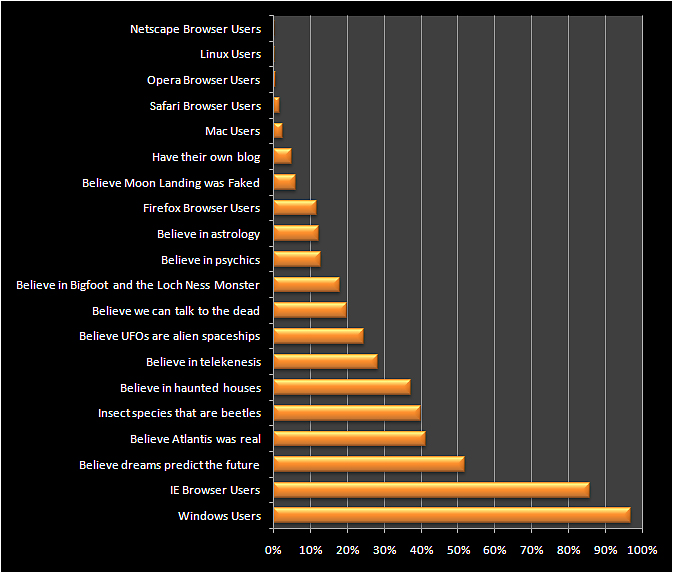
About 18% of the US population believes that Bigfoot and Nessie will eventually be found. Only about 3% have chosen to believe the marketing claims around the Macintosh and Linux operating systems. If the Internet was a level soapbox, we would see six times more buzz on Bigfoot and Nessie as we do on Mac and Linux. That means that there would be 44.7 blog posts about animals that are quite possibly imaginary for every one post about the Linux operating system.


Or if you took all the Mac and Linux people and organized a tug of war against all the people that think that the moon landing never happened, the moon landing people would win. By a lot. It wouldn’t really be a contest because the Mac and Linux people, again, make up about 3% of the operating system market and the “Moon landing was faked” crowd are double that number or 6% of the US population.

Just a note: I know that I'm playing a little fast and loose with these numbers, but I'm making sure that I'm coloring inside the lines. If you double all the Mac and Linux numbers and halve all of the rest of the numbers, these points would still be valid.

Africa has about 3% of world Internet usage - again, a little more than Mac and Linux users combined. Assuming that all Mac and Linux people participate on the Internet we can get a feel of what the relevant contribution their percentage of people should feel like. All the packets that go through the network backbones that address African issues do not begin to compare with Mac and Linux packets. By the way, African Internet usage is up 625.8 percent this year. Apple and Red Hat don't even dare to dream of that level of growth, but it is out there.

Assuming that the Internet is a truck and not a series of tubes, Mac and Linux users can be represented by a large stuffed animal flopping around the empty bed. Or if we want more of a "series of tubes" like example, think of draining only a gallon of water from a very full bathtub. Oh, and Chicago has about 3% of the US population. Five percent, which is roughly twice the number of people that make up Mac and Linux users, think that The Da Vinci Code is real. Globally, 5% of people online have a blog. Three times (13%) as many people believe that Lee Harvey Oswald acted alone to kill JFK than use Mac and Linux operating systems. On a much more sobering note, roughly the same percentage (12.5%) of the U.S. population is living at or below a subsistence level.

The world is not how I would have it. And Ok, so the internet is not a level playing field and never will be. Returning to levity, I know that there is no way you could get Macintosh and Linux users together to do anything, much less all play tug-of-war. Having them pull the same direction at the same time would be unprecedented. Actually, it would be beyond amazing if you could get even 50% of just the Linux users pulling the same direction. But this whole subject still bugs me.

I recently saw this quote in the Seattle Times, "Nobody makes a move at music, movie, computer, phone and consumer-electronics companies nowadays without first asking themselves, what would Jobs do?" Some of that quote I understand, but come on!

The buzz and respect Macintosh computers gets is unworldly. Although Microsoft is begrudgingly invited to the table, Apple will sit at the head and get all the attention. This is like the President of the USA running everything past the mayor of Chicago. (Maybe this explains a lot!) Why aren't Macintosh users treated like the "Moon Landing was Faked" crowd? How come subcultures that are four or five times larger in size than the Mac people get a thousand times less respect?


I think I remember when I was working on Mac Word 5 that the Macintosh had about a 20% market share. Now they are sitting at 2.5%. Why on earth would anybody deify the company that lost that much market share? In 1980 Apple had a 26% market share. Radio Shack was more successful! So Apple has gone from 26% to 2.5%. Apple computers have always been a second or third ranked player. If I were a betting man, I'm not sure the smart money is on Jobs/Apple holding on to their iPod market domination. I mean, I hope they do. I have nothing against Apple (well, one thing from the Mac Word days) and I absolutely worship the Apple marketing team. How on earth can they keep their company as the top PC go-to-guy?

When I was four years old I started on a grand quest for fairness. Although I try, I haven't ever been quite strong enough to stop it. I know this isn't how the world works, but still, it just doesn't seem fair that Macintosh users have the status level of cheerleaders instead of conspiracy nuts. Everyone of their PC versus Mac guy commercials make me grind my teeth. For 20 years Apple's battle cry has been "Apple good, PC suck". Isn't it time that they stand on their own? Win or lose the debate on what is great about the Macintosh OS alone, not just as a warped mirror of the PC. There is a market of people that will buy anything other than Windows; the size of that market seems to be around 2.5%. Apple used to be about more than that.
And as far as Linux users go, the real ones that I've met really have been conspiracy theorists. Many of them seem to be united against Microsoft rather than for something else. But I have to say that I haven't really spent too much time thinking about them. With 0.4% of the market share, I'm not quite sure why I should. OK, yes, I had to play with the technology and keep my fingers in the pot. And also I had to do some research when what I was hearing and what I was seeing became very different. Windows Servers lead Linux Servers with nearly 20% more annual uptime. This is because of, according to the Linux people, bad documentation. It bothers me that Linux users talk about their bright new and shiny OS. Anybody can look it up and see that GNU came out the same year as MS-DOS 3.0 and Linux came out the same year as Windows 3.1. Between all the hype and hate speech, they just lost me somewhere. A part of me used to root for them in that cute underdog kind of way, but now it just seems sad.


So big bad Microsoft doesn't need me to stand up for them. With a 97% market share they don't need to stand up for themselves. I suppose that explains why Mac and Linux users can take on the airs that they do. Microsoft will never squash these two systems because it is in their best interest for them to have at least a tiny bit of competition to show to the monopoly committee. Nobody will ever accuse Microsoft of really being fast to market on the bleeding edge, but they are good competitors and have done a reasonable job improving people’s computer life inch by inch. But that doesn't make me feel better either.


I was there when the big operating system wars were happening. MS-DOS and CP/M were slugging it out with graphical interface operating systems. Macintosh OS and Windows and IBM's OS/2 were at each other's throats. More innovation happened in one year back then than in five years now. (God I sound old!) OK, I know some of that was because there wasn't the fragile user installed base that there is now, but I don't think that would stop a lot of innovation if the people behind these operating systems were competing against each other claw and hoof.

I want wonderful things. I want my computer to reinvent itself with more than just another slightly buggy "Web 2.0" (what ever that really means) application. The operating system is like the foundation for everything. It is all if the utilities that run in to my house all put together. This should be bigger than it is now, it should be more exciting and it should be like something I would read in a science fiction story.


Speaking of Science Fiction, sometimes I feel slightly miffed that I don't have the flying car that was promised to me by Disney World's Horizons. But it does seem like if I can't have OS innovation or a flying car or even a jet pack, can we at least get rid of the PC / Mac TV commercials?


Click here for a reasonably sized picture of the following chart.


Friday, February 9, 2007

How to be Remarkable & Is Your Boss an Asshole?

The Battle of the Asses

Blogger has made a mess of the formatting of this post, but I wanted the table layout more than anything else. The HTML is clean (except to blogger) and you can see a clear version of it here. I hate blogger. While reading this on blogger, be sure to scroll down a lot.


When I read Guy Kawasaki's post this morning, I couldn't help but recall Seth Godin's post from a few months ago.

Are these top marketing pundits describing the same person? (I didn't change the order of these, only published these side by side)


Seth Godin's
How to be
Remarkable


Guy Kawasaki's
Is your Boss
an Asshole?


Understand the
urgency of the situation. Half-measures simply won't do. The only
way to grow is to abandon your strategy of doing what you did
yesterday, but better. Commit.
Thinks that the rules are
different for him
For example, a parking space for handicapped
people is really for handicapped people plus him because his time is
so valuable that he can’t walk fifty additional feet. Or, the
carpool lane is for cars with multiple people, hybrids, and her
because she’s late for a meeting
Remarkable doesn't
mean remarkable to you. It means remarkable to me. Am I going to
make a remark about it? If not, then you're average, and average is
for losers.
Doesn’t understand the
difference between a position making a person and a person making a
position.
The vice-president of acquisitions for a big media
company is a big deal, but all her power, and therefore the ability
to act like an asshole, evaporates without this title. Assholes
usually don’t understand that their current position affords them
temporary privileges.
Being noticed is not
the same as being remarkable. Running down the street naked will get
you noticed, but it won't accomplish much. It's easy to pull off a
stunt, but not useful.
Requires “handlers.” This
means a personal assistant, appointments secretary/lover, public
relations flunkie, and chauffeur. It’s funny but if an asshole
didn’t have the position/money/status, he would probably be able to
answer the phone, make appointments, talk to the press, and drive
himself.
Extremism in the
pursuit of remarkability is no sin. In fact, it's practically a
requirement. People in first place, those considered the best in the
world, these are the folks that get what they want. Rock stars have
groupies because they're stars, not because they're good looking.

Requires the fulfillment of special
requests in order to be happy/productive/efficient.

For example, she needs a special brand of spring water from the
south of France bottled by chanting monks when she’s making
a speech. This type of actions represent flexing for the sake
of flexing—not because any of this crap is necessary.


Remarkability lies
in the edges. The biggest, fastest, slowest, richest, easiest, most
difficult. It doesn't always matter which edge, more that you're at
(or beyond) the edge.
Requires the fulfillment of
special requests in order to be happy/productive/efficient.
For
example, she needs a special brand of spring water from the south of
France bottled by chanting monks when she’s making a speech. This
type of actions represent flexing for the sake of flexing—not
because any of this crap is necessary.
Not everyone
appreciates your efforts to be remarkable. In fact, most people
don't. So what? Most people are ostriches, heads in the sand, unable
to help you anyway. Your goal isn't to please everyone. Your goal is
to please those that actually speak up, spread the word, buy new
things or hire the talented.
Relates to people primarily
in terms of what they can do for him.
In other words, “good”
people can do a lot for him. “Lousy” people aren’t useful. The way a
lousy person becomes a good person is by showing that he can help
your boss in some way.
If it's in a manual,
if it's the accepted wisdom, if you can find it in a Dummies book,
then guess what? It's boring, not remarkable. Part of what it takes
to do something remarkable is to do something first and best. Roger
Bannister was remarkable. The next guy, the guy who broke
Bannister's record wasn't. He was just faster ... but it doesn't
matter.
Judges people by her personal
values, not the employees’ or society’s values.
Assholes judge
people according to only what they think is important. For example,
a boss may value only professional accomplishments, so someone who
is “merely” a mom or dad with a focus on a family is therefore
inferior
It's not really as
frightening as it seems. They keep the masses in line by threatening
them (us) with all manner of horrible outcomes if we dare to step
out of line. But who loses their jobs at the mass layoffs? Who has
trouble finding a new gig? Not the remarkable minority, that's for
sure.
Judges employees’ results and
his intentions.
A boss never comes up short when he juxtaposes
his intentions (“I intended to do your quarterly review”) versus an
employee’s results (“You didn’t finish the software on time”).
Instead, a boss should judge his results against his employees’
results and never mix results and intentions
If you put it on a
T-shirt, would people wear it? No use being remarkable at something
that people don't care about. Not ALL people, mind you, just a few.
A few people insanely focused on what you do is far far better than
thousands of people who might be mildly interested, right?
Asks you to do something that
he wouldn’t do.
This is a good, all-purpose test. Does your boss
ask you to fly coach while she flies first class? Does she ask you
to work weekends while he’s off at a hockey tournament? I’m all for
using boss time effectively (for example, not making her drop off a
package at Federal Express), but were it not that your boss could be
doing something more valuable for the company, would she do what
she’s asking you to do?
What's fashionable
soon becomes unfashionable. While you might be remarkable for a
time, if you don't reinvest and reinvent, you won't be for long.
Instead of resting on your laurels, you must commit to being
remarkable again quite soon.
Calls employees at home or on
the weekends.
Rarely, as in once per year, this is okay, but any
more often and your boss is certifiable. His happiness is not your
problem 24 x 7. You are entitled to your personal time and space
because slavery was abolished a long time ago in America.
Believes that the world is
out to get her when faced with criticism or even omission.
For
example, bloggers don’t write about her because they are all jealous
of her. Frankly, it’s more likely that he’s not worth writing about
than the blogosphere is colluding against him. This boss needs to
learn that “it’s no always about her.”
Slows down or halts your
career progress.
One can forgive or ignore the previous nine
issues, but this one is by far the worst thing an asshole boss can
do. Usually it’s a matter of convenience: “How can you leave me? I
need you.” For doing this, a boss should go into the anals (sic) of
asshole-dom. God didn’t put you on this earth to make your boss’s
life better, so don’t hesitate to abandon a boss who holds you back.