Showing posts with label Microsoft. Show all posts

Friday, August 3, 2007

Office competitor: It's Partner, Pave or Pace

http://www.techdirt.com/

Cool site. Way oversimplified: Companies ask a question and pay for the top 3 answers

One of thier question:


Alternatives To Microsoft Office: Two Goliaths -- What Does David Do Now?
Top 3 Insights Receive $150 Each.
Google has received quite a bit of attention for the beginnings of its office productivity suite that can operate collaboratively online (as well as offline with Google Gears). But there are already several non-Microsoft office suites that are much more mature than Google's current office apps. However, by adding the weight of its brand to the Web2.0 productivity market, Google has apparently stolen the "thunder" of the upstarts who were pitching stones at Microsoft. As one of these alternative office suite developers,
1) What are the weaknesses of Google Docs & Spreadsheets?
2) How does a smaller office software firm promote itself with two giants in the same arena?

I got to thinking about it and wanted to answer it here:

My first answer is to do better research. Office has over 85% of the market. There are not two Goliaths, there is one Goliath and somebody else with a very big mouth.

But I think the solution has to come down to: Partner, Pave or Pace.

Partner:
Do add-ons or extensions to one of the big guys. There is quite a bit of money here as the Goliaths like these people. They don’t have time to enable every feature in the world, but they have given the functionality to do this. They will even pick up a lot of your marketing expenses if you can get their attention.

Pave:
No big company is fast. (Even Google, despite what they say.) There will always be space on the bleeding edge. For example, the last bleeding edge was getting reasonable editors into the different blogging web sites. Word 2007 can do that now, so that opportunity is fading, but I’m sure there is another one raising somewhere. Yes, you will be paving the way for the big guys, but there will always be room here. Monetization might be hard.

Pace:
Run next to the big guys. Find a vertical or two and own it. This is what Apple has done. I would stay away from legal cuz it looks like the big guys are going there, but there are still lots of places untouched.

A combination of all three would probably bring the best results.

Sunday, February 18, 2007

10 Things to Think About For Your First Web Site

A person I know has recently decided to take the plunge and develop her first web site for her business. She is, she says, "a people person and not a computer person". She is understandably a little lost as to how to even get started. Below is my answer to her.

Most non-technical people have no idea of how much of their time and money they are going to need to spend to have somebody do this. Everybody wants something like http://www.vulcan.com/ without having any idea that this site was probably way over 40K to produce and it’s hard to imagine how many artists, sound editors, flash animators, writers, editors, photographers, developers, testers, project managers and time went into it. You can get a very good site for $500 to $1,000 if you are very organized and willing to compromise.

You will generally get a better site and it will generally take much less of your time if you can spend more money, but I’ve seen some amazing sites done for very little money because the customer was so well prepared. There are some key things you can do that will make any site better and also reduce the costs. You should do most of this before you get real estimates for your site. Since it is harder to do this on the cheap, I will focus there.

Rules for a cheaper web site:

1. Know the vision, mission and goals for your website. It is probably marketing related; describing the business, contact information and maybe gathering names for a mailing list. But you might also want to ease office processes, like having forms to fill out or something like that. Go to your competitors' web sites and see what they do and what you like. Add these site addresses to your Favorites.

2. Let your webmaster pick a template for you and stay away from creating a design or a "look". If you get too much into what colors should be next to each other and how much space there should be between thing x and thing y add at least a $1,000 if not $10,000. In general it is cheaper to mix in on the design side as little as possible. I used to tell my customers on a budget "Don't let perfect stand in the way of good." Pick your colors in a general way like a bride might. Be ready to show a few printouts from a variety of designs of sites you liked from step #1. But otherwise just stay open. It never hurts to ask questions but something as little as specifying rounded corners .vs. square corners can cost you a bundle and send everything back to the drawing board.

Stay away from anything very arty. Pictures are OK, but not animations. Very arty sites are very hard to do well. Most of them are way too slow, are not very usable and do not get along well with the search engines. Technically most of what I’m trying to say here is; for sites done on the cheap, stay away from the computer program called Flash.

3. You will probably need your own URL. There are whole books written about this. It's a big deal. If you have any doubts at all, get some help. http://www.networksolutions.com is the site to test different naming ideas. You can also go to http://www.networksolutions.com/whois/index.jsp and they will tell you who owns the URL. Even if they show a domain as unavailable, it's often worth going there or doing a google search for it. There are companies like http://www.vztools.com/ that buy lots of address for the express point of reselling them. Often times they are not that much more expensive than going through Network Solutions.

4. You probably want your site to be professionally hosted and you will write a check to these people every month. There are free site hosters but your customers will really pay a bad price for this and it doesn't reflect well on you. There are lots of little things that will make a big difference in the price. Things like having the address be www.~~~~~.com is more expensive. Having five email addresses at person@~~~~~.com is probably free. Having 6 may cost you $10.00 extra a month. How many visitors you think you will have will be important. Are there going to be photos and videos on your site or will you link to other sites. Be willing to dive in here and really think these things through.

5. Document the kind of words your customers would type into a search engine to find you. These are called keywords for obvious reasons. I would recommend spending at least 40 hours on this. Yes, it really is worth a week of your time. Search for your competitors and see what words work for them and where they get listed. Make sure you have this down cold. You will need to create a Priority 1 list of approximately 20 to 40 words for the search engines. *

6. Create as much of the site as you can in Word or Excel. Use all the buzzwords that you came up with in the previous step as much as possible while creating easy to read prose. Make sure that you have all the pictures/photos done and all the copy solid. I mean solid as in “it's been through a professional editor” solid. Good professional editors that do not take very long to go through a few documents are are worth their weight in gold. Changing any of this stuff after the webmaster has done their magic will be much more expensive.

7. Now, if you want, you can take a shot at bringing up your own site. For a non-technical person I think this is similar in scope to asking a novice to create a real TV commercial by themselves, so expect a bit of a bumpy ride. Right now for sites on the lower end I like http://smallbusiness.yahoo.com/webhosting/ (they charge ~$8 a month) or http://www.officelive.com. There are lots of others, but these guys are not going anywhere. If you run into problems, get help first from a more technical friend before your paid consultant.

Bring up a space on MySpace. It will be ugly, but the experiance will be good for you and it's something you will probably need to do anyway and at least you will understand what MySpace is about.

8. With all that said, if I didn’t have any web presence in this day and age I wouldn’t start with a static web site. I would start with a blog. To answer the question of why this is true would take a whole other post, but users now expect a site that has dynamic content and they also want to forge a personal link with you. Plan on posting new entries at least three times a week, 5 days a week would be better.

9. Jump into the water and get your toes wet right now. You can do it without having to do all the dreary prep work listed above. All of the following sites have templates and you can you play around getting things the way you want all the time. I have a blog on just about every service for fun. I put my mother and mother-in-law on http://spaces.live.com/ because it is by far the easiest to use. http://www.facebook.com is another direction that might be a good start. For the more technical business types I would tell them to check out http://www.terapad.com. All of these are free, which is somehow OK in the blog world. http://www.vox.com/ is fun too.

10. It doesn't matter if you went with a blog or a site, now you need to get the name out. There are lots of tricks to do this and I say avoid them all. Just do a very good faith effort to 1) make your site relevent to your customers 2) take the word of your site to them, for example make thoughtful posts on other people's blogs and leave the address to your blog, and 3) give it some time. The Internet is a big place and it takes some time for it to sort itself out.


None of this is that hard, assuming you use templates for the design of your site and you have a technical friend that can be bribed by beer and/or cookies to get you through the rough spots. I think that non-technical types would be happier having the site built by somebody else but would do just fine with a blog.

Dive in and good luck!


* From the Keyword step:

A trick that may help generate keyword ideas is, as you visit competitors' sites, right click on the white space on the page and then choose “View Source”. You will then see a bunch of text/tags, most of which we don’t care about. Look for a section that looks something like: "META NAME="Keywords" CONTENT="Power, performance, motivational, inspirational, quotes …” with angled braces around it. This is the list of the keywords that your competitors think are important and where your list of priority one keywords is destined to go. This will not work on every site, but is generally worth a try.

Friday, February 16, 2007

Apple and Linux in Proportion


Or why Bigfoot can clean the floor with Mac and Linux.


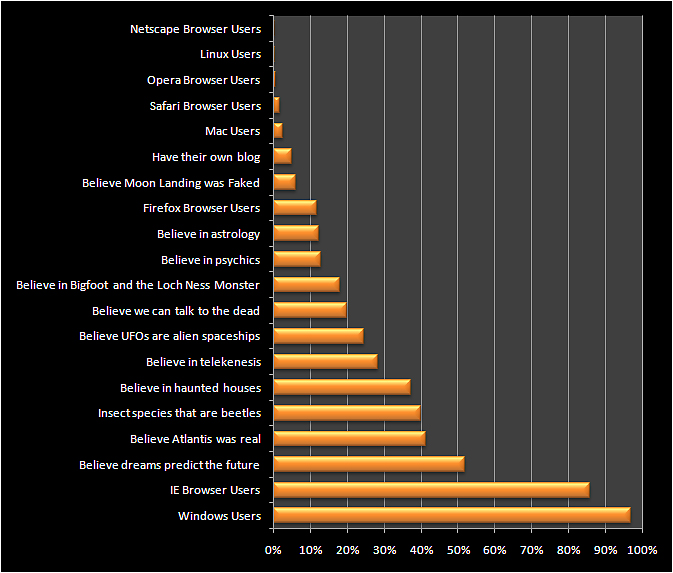
About 18% of the US population believes that Bigfoot and Nessie will eventually be found. Only about 3% have chosen to believe the marketing claims around the Macintosh and Linux operating systems. If the Internet was a level soapbox, we would see six times more buzz on Bigfoot and Nessie as we do on Mac and Linux. That means that there would be 44.7 blog posts about animals that are quite possibly imaginary for every one post about the Linux operating system.


Or if you took all the Mac and Linux people and organized a tug of war against all the people that think that the moon landing never happened, the moon landing people would win. By a lot. It wouldn’t really be a contest because the Mac and Linux people, again, make up about 3% of the operating system market and the “Moon landing was faked” crowd are double that number or 6% of the US population.

Just a note: I know that I'm playing a little fast and loose with these numbers, but I'm making sure that I'm coloring inside the lines. If you double all the Mac and Linux numbers and halve all of the rest of the numbers, these points would still be valid.

Africa has about 3% of world Internet usage - again, a little more than Mac and Linux users combined. Assuming that all Mac and Linux people participate on the Internet we can get a feel of what the relevant contribution their percentage of people should feel like. All the packets that go through the network backbones that address African issues do not begin to compare with Mac and Linux packets. By the way, African Internet usage is up 625.8 percent this year. Apple and Red Hat don't even dare to dream of that level of growth, but it is out there.

Assuming that the Internet is a truck and not a series of tubes, Mac and Linux users can be represented by a large stuffed animal flopping around the empty bed. Or if we want more of a "series of tubes" like example, think of draining only a gallon of water from a very full bathtub. Oh, and Chicago has about 3% of the US population. Five percent, which is roughly twice the number of people that make up Mac and Linux users, think that The Da Vinci Code is real. Globally, 5% of people online have a blog. Three times (13%) as many people believe that Lee Harvey Oswald acted alone to kill JFK than use Mac and Linux operating systems. On a much more sobering note, roughly the same percentage (12.5%) of the U.S. population is living at or below a subsistence level.

The world is not how I would have it. And Ok, so the internet is not a level playing field and never will be. Returning to levity, I know that there is no way you could get Macintosh and Linux users together to do anything, much less all play tug-of-war. Having them pull the same direction at the same time would be unprecedented. Actually, it would be beyond amazing if you could get even 50% of just the Linux users pulling the same direction. But this whole subject still bugs me.

I recently saw this quote in the Seattle Times, "Nobody makes a move at music, movie, computer, phone and consumer-electronics companies nowadays without first asking themselves, what would Jobs do?" Some of that quote I understand, but come on!

The buzz and respect Macintosh computers gets is unworldly. Although Microsoft is begrudgingly invited to the table, Apple will sit at the head and get all the attention. This is like the President of the USA running everything past the mayor of Chicago. (Maybe this explains a lot!) Why aren't Macintosh users treated like the "Moon Landing was Faked" crowd? How come subcultures that are four or five times larger in size than the Mac people get a thousand times less respect?


I think I remember when I was working on Mac Word 5 that the Macintosh had about a 20% market share. Now they are sitting at 2.5%. Why on earth would anybody deify the company that lost that much market share? In 1980 Apple had a 26% market share. Radio Shack was more successful! So Apple has gone from 26% to 2.5%. Apple computers have always been a second or third ranked player. If I were a betting man, I'm not sure the smart money is on Jobs/Apple holding on to their iPod market domination. I mean, I hope they do. I have nothing against Apple (well, one thing from the Mac Word days) and I absolutely worship the Apple marketing team. How on earth can they keep their company as the top PC go-to-guy?

When I was four years old I started on a grand quest for fairness. Although I try, I haven't ever been quite strong enough to stop it. I know this isn't how the world works, but still, it just doesn't seem fair that Macintosh users have the status level of cheerleaders instead of conspiracy nuts. Everyone of their PC versus Mac guy commercials make me grind my teeth. For 20 years Apple's battle cry has been "Apple good, PC suck". Isn't it time that they stand on their own? Win or lose the debate on what is great about the Macintosh OS alone, not just as a warped mirror of the PC. There is a market of people that will buy anything other than Windows; the size of that market seems to be around 2.5%. Apple used to be about more than that.
And as far as Linux users go, the real ones that I've met really have been conspiracy theorists. Many of them seem to be united against Microsoft rather than for something else. But I have to say that I haven't really spent too much time thinking about them. With 0.4% of the market share, I'm not quite sure why I should. OK, yes, I had to play with the technology and keep my fingers in the pot. And also I had to do some research when what I was hearing and what I was seeing became very different. Windows Servers lead Linux Servers with nearly 20% more annual uptime. This is because of, according to the Linux people, bad documentation. It bothers me that Linux users talk about their bright new and shiny OS. Anybody can look it up and see that GNU came out the same year as MS-DOS 3.0 and Linux came out the same year as Windows 3.1. Between all the hype and hate speech, they just lost me somewhere. A part of me used to root for them in that cute underdog kind of way, but now it just seems sad.


So big bad Microsoft doesn't need me to stand up for them. With a 97% market share they don't need to stand up for themselves. I suppose that explains why Mac and Linux users can take on the airs that they do. Microsoft will never squash these two systems because it is in their best interest for them to have at least a tiny bit of competition to show to the monopoly committee. Nobody will ever accuse Microsoft of really being fast to market on the bleeding edge, but they are good competitors and have done a reasonable job improving people’s computer life inch by inch. But that doesn't make me feel better either.


I was there when the big operating system wars were happening. MS-DOS and CP/M were slugging it out with graphical interface operating systems. Macintosh OS and Windows and IBM's OS/2 were at each other's throats. More innovation happened in one year back then than in five years now. (God I sound old!) OK, I know some of that was because there wasn't the fragile user installed base that there is now, but I don't think that would stop a lot of innovation if the people behind these operating systems were competing against each other claw and hoof.

I want wonderful things. I want my computer to reinvent itself with more than just another slightly buggy "Web 2.0" (what ever that really means) application. The operating system is like the foundation for everything. It is all if the utilities that run in to my house all put together. This should be bigger than it is now, it should be more exciting and it should be like something I would read in a science fiction story.


Speaking of Science Fiction, sometimes I feel slightly miffed that I don't have the flying car that was promised to me by Disney World's Horizons. But it does seem like if I can't have OS innovation or a flying car or even a jet pack, can we at least get rid of the PC / Mac TV commercials?


Click here for a reasonably sized picture of the following chart.


Sunday, January 28, 2007

Managing a Test Manager or Seeing the Big Picture

I was waxing nostalgic about my old career as a test manager and found a blog entry that was the same rant that I used to rant about all the time: http://shrinik.blogspot.com/2006/12/why-counting-is-bad-idea.html

I wrote comment on the blog, and although it’s written to other testers, I think its biggest value could be to those people that have to manage test managers.

When I was a test manager, almost without exception, I was managed by people who had no clue about a) the purpose of test b) what test managers and test teams could do for them and c) when or why test needed any of their time, except for ship weeks. I had to teach my bosses the answer to all three of those things, but it was often hard because they thought they had the answers.

One of the lessons I learned as a test manager combined with those I learned running my own business can be summed up as this: Achieving the big picture is more important than getting people to tell you about it. Yes, managers have to know the progress towards a goal, but there is a right way and a wrong way to achieve that. I think every manager needs to be reminded occasionally that the purpose of employees is not to make their job easier. And sometimes, like with a test team, it isn’t as straight forward as it seems. Understanding the underlying strategic purpose of each person or group’s job is really the key to success.


-------------------------------------


Ok, back to the post, "Why counting is a bad idea", basically says that anybody who thinks that they are getting good information when test is forced to produce reports that say things like: “Number of Test cases prepared: 1230, Number of Test cases Executed: 345, Number of Test cases Failed : 50” is wrong.


As an ex-test manager I disagree that numbers are bad, they are vital, but probably not why you think.

The purpose of testing is not to find a large number of bugs. I remember a project where I had two very different developers. Developer 1 was a little sloppy and did mostly UI type programming and his weekly large check-in was worth an easy 20 bugs. Developer 2, who was a god, did the deep architectural stuff and did a check in perhaps every month. We were lucky if we got one bug off of his code with a solid week of testing. Typically all the bugs from the testers of these developers were high risk bugs, but 80 bugs to 1 bug was no way to judge the productivity of the testers or the stability of the product.

Testing’s job is not about quality assurance, either. Everybody on the entire product team must own quality. If anything close to a “They will find this in test” attitude grows in your development team, that product is doomed to be low quality. This product will never feel right, it will never be smooth. No matter how much time and effort the test team puts on it. The old joke between Microsoft Test Managers was “I own quality for the length of time it takes my boss to walk to my office.”

So, if the purpose of the test team isn’t to find a large number of bugs (even high risk bugs) and it’s not to assure quality, what is it that they are asking us to do?

The purpose of the test team is to accurately communicate the status of the product.

The amount of testing applied and the number of bug reported are the best way to know the current status. But only when the status is communicated in context of the entire environment, which includes people, bugs and coverage, project goals and schedule. Those that try to simplify something thing this big and complex in to “500 cases run and 4 bugs” is very likely to have a huge surprise waiting for them at ship time.

Or to put it another way: A spec isn’t done when it hits 100 pages, why is it logical to think test is done at 100 test cases?

In the above example, I, the test manager, knowing what I know about the changes the developers are making and seeing the number, location and types of bugs, and by talking to the whole product team (especially testers), could make a very good educated guess as to accurate product status.

I could say something like, on a scale of one to ten, we are a three. Last week we were a two. But there is a lot of new code coming in, so I suspect next week we will be a two again. But after that, we are doing a stability drive towards beta, and if things go as planned, and we are mostly on track for it; right now I have a confidence level of nine. These are the numbers they really want, but don’t know how to ask for. This kind of roll-up needs to be done for all the different product areas, too.

If you do not give the rest of the product team that kind of black and white numerical status roll-up, they will find some horrid way to squeeze one out of you, and they generally go to test cases or worse.

One exception to numbers that I have seen work is pictures. I’ve known of some product unit mangers that were most happy with something as simple as a picture of a stop light. Green – Things were humming along as planned, Yellow – there were some storm clouds gathering that should be addressed now and Red – the product was blocked or there was some other huge catastrophe. It sounds simple, but it generally takes the test manager quite a few hours to accurately color.

The management team just wants some simple way to accurately know the status of the project. It’s not their desire for numbers that is wrong. In a void of anything else, they ask for what they think they want. It works out much better if the test team can supply them with the status numbers they really need before they think to ask for those other abominations.

Monday, January 22, 2007

Google plots e-books coup

Google plots e-books coup - Sunday Times - Times Online


Every seven years somebody resurrects the idea of eBooks. I was on the Microsoft Reader 1.0 team in 2000. They were some of the best days of my life. We had a saying: Every seven years the eBook comet comes back through earth’s solar system. We thought that we were the generation that was going to make the comet impact on earth, but we only got it to graze the planet. Now it looks like Google is going to take up the current rotation. I wish them a better ride than we had and thought I would share some of the lessons I learned.


Do NOT talk to the Publishers.

As a rule these guys are greedy and clueless. Just look at what the record producers are doing for media players and you get a sense of what these guys can do to eBooks. There are exceptions, but I still wouldn’t get into bed with them. These guys sucked 30 to 60% of the eBooks business development and marketing efforts away and we had very, very little to show for it. What little we did get wasn’t enough in the end. The book industry has been struggling for 30 years. Things are so confused that many authors are not sure who, if anybody, has the rights to publish their books in an electric format. Their book may not even exist any longer in electronic format. Anything easy you ask the publishers to do for you will be almost impossible for them. They can sure talk a good talk though. They had our guys going the whole time. Every time your business development person falls into the trap of thinking that all will be well if we get the publishers in our playground, slap him/her very hard.

Oh, and approaching authors directly was a lot of fun but ultimately just as frustrating.


Figure out a way to do both paper and screen layout.

Adobe Reader is all about paper page layout. If an author says that word “x” is the last word on page 1, then word “x” will always be the last word on page 1. It doesn’t matter if the document is being viewed on a 21 inch flat screen or a cell phone. This is necessary for business documents where you want to be able to say something like “Turn to page 24 of your document” and have it be meaningful.

Microsoft Reader went the opposite direction; we were all about the screen. We invented ClearType and gave it to the operating systems. A LIT file will always format itself as best as it can for the screen it’s being displayed upon. There isn’t even a concept of real paper. If you wanted to print out a passage from a book you need to copy and paste it into a different program. But the readably inside the Reader is to die for. No matter what your screen size, you can almost smell the scent of fine heavily clayed paper.

Both of these programs are correct. As an author sometimes I will want one and sometimes the other. Sometimes a document will only work one way and sometimes the mode I need is situational. I need the reader to do the right thing on every platform and screen size or give me an easy way to control this as an author.

Microsoft = readability and immersion. Adobe = business and collaboration. Put both of these together and the world will beat a path to your doorstep.


It *so* isn’t about DRM.

About 30% of the Microsoft Reader’s product team’s efforts went into DRM and it was a pretty big failure. Yes, some sites still use it, although it has been hacked a few times. Mostly you hear users that have over $100.00 worth of eBooks who can’t read their books any longer clamoring for Congress to do something. So to sum it up, Microsoft Reader DRM really made people angry and it didn’t work.

The thing that is saving the record industry is new artists and people ripping their old CD’s. The new artist angle can work for eBooks but not the CD ripping. So if your efforts to get current content will be mostly fruitless that leaves new content. That’s OK, there is a boom going on in the self publishing industry and it’s only going to get better. Everybody who has kept a blog for any length of time could easily create a book and already has an audience.

To avoid DRM, but to keep it simple, you have two kinds of eBooks; those with advertising and those without. Just like the Google Blogger model, it is up to the author which path they would like to go down. This way if somebody posts the eBook, that’s great! They email it to their friends, great! There is no genie to keep in the bottle because there isn’t a bottle.

I would also add the sub-case where a book can be sponsored, but that could probably wait for the second version. It would be nice if the advertising payback could be enough that best selling authors will still be able to make about the same amount of money or more. It would be nice if the authors could have some say over what ads go into their book. It would be nice if the author could choose to include more or less ads to change their monetary rates. It would be nice to do a bunch of other things, but all of them pale in comparison to the effort it takes to do a small DRM system.


Other Random Notes:

Don’t count Microsoft out. The number of LIT files that are sold each quarter steadily grows. It is sites like this and this and Powells that keep the train chugging along. Yes, the Reader program itself is getting a little long in the tooth, but the new stuff in Word is very cool. But the real core, the people that made up the heart and soul of the Reader team, still work together. They could suit up and be taking prisoners very quickly if Microsoft decides to really go down this road again.

I would try to keep eBooks as just one of my design criteria. For example, I read all the time, but only some of that is done in pBooks or eBooks. It would be nice if my RSS feeds were on my device every morning and I could go through during lunch them in a pretty way. Or perhaps any RSS post that was over 3000 characters would automatically switch to an easier to process format. A lot of people on the Reader team would create photo albums in LIT format because they were so beautiful on every device and also had the killer compression.

Be the king of the study guide. Everybody uses their computers to do research. I want to be able to bookmark content in blogs and web pages, office documents and PDFs, etc. I want to be able to do it by keyword. So if I’m writing an essay on something, I can bookmark anything that looks interesting and it all comes together in a Google eBook for me to study.

Join me and worship at the feet of Bill Hill and OSPREY. Not all the time, but whenever possible.
Empower anybody to create a document for your reader. Try to stay as far away as you can from creating authoring tools. I would look seriously into using Word’s new .DocX XML format as my native format. (It is now an open standard approved by ECMA and free to use.) It would rock if you could read PDF and LIT files.

Ok, this one is really cynical, but by law publishers need to offer handicapped people a reasonable product experience. Publishers may be more inclined to offer their books in your format if your reader is the absolute best for disabled people. I would also make sure the non-profits that might pursue this are well funded.

Give money to the University of Virginia Library. They rocked and Microsoft kind of left them high and dry when the Reader team was reorganized.

NIST used to be really into eBooks and were doing a great job driving reasonable standards but I don’t see anything current on their web site.

Automatically create the infrastructure so that every eBook has its own web community (social) on your servers. Capture the author's contact information and keywords and a summary, and of course an advertisement. Allow the author to customize these sites and sign up for a cut of the advertising revenue. Yes, 98% of these communities will languish, but they are still helpful just in their uniformity. The ones that take off will more than make up for any costs here. (Imagine if you got a penny for every web page ever written…)

Do *not* piss off librarians. They are very nice people and very, very smart. As much as the publisher’s don’t get it, librarians do. Also, nothing will happen in this space without them. Win them to your side early and court them constantly.

Expect some pretty bruised feelings from customers, vendors, ISVs, publishers and authors. We (the Microsoft Reader team) were so sure that this time was the time and it ended up we were wrong, the comet needs to make another pass. I wish Google the best.

Sunday, January 21, 2007

Open souce OS - You get what you pay for.

The “My father has a barn, let’s all put on a play!!!” of software operating systems. Or one of the places where the t-shirts have it wrong.

Open Source: This is a term that most people are familiar with, but it's worth re-stating. The open source revolution, where information is freely distributed and editable, is already reshaping a number of industries and upsetting traditional economic and intellectual property models. Wikipedia has very quickly become the world's largest repository of encyclopedic information. Linux and other open source software continue to rival the big players. And looking further down the line, there's the potential for open source science, culture, and the disturbing potential for open
source warfare
. -- http://sentientdevelopments.blogspot.com/2007/01/must-know-terms-for-21st-century_11.html


I hate how these religious zealots steal the meaning whenever anybody does anything nice. They claim that Ben Franklin was all about Open Source. Just because people want to give something back to the community doesn’t mean they want to give it all. Read Franklin’s autobiography, he was very clever in how he went about making his fortune and doing good things for society at the same time, not in exclusion to each other.


And I absolutely love the “open source software continue to rival the big players.” They can never give me one example. Netscape was a huge before it was Open Source, but now it has a less that 1% market share. If Linux was going to take off it would have already. Linux market share is 0.37%. Yes, that’s right. The software that is “rivaling” the big players has less than a 1% market share after over 15 years of trying. Linux first came out about the same time as Windows 3.1 did. (Market Share Source = http://marketshare.hitslink.com/report.aspx?qprid=2.)


Yes, free is a great thing to college students. It’s very cool to hate Microsoft. Apple computers haven’t been that wonderful lately (4.15% market share). And it makes a person feel so empowered to be writing chunks of operating systems before they’ve graduated from college. Our rebellious lost boys need a wonderland; they need to find Open Source Land where everything is free (especially food and rent) and everybody always does good things for each other and all the problems are equally hard and fun to work on and candy grows on trees.


I know people that worry about this while working at Microsoft. They think that Microsoft’s short term prospects are dim because of open source. And it does seem like the one thing that all the open source people all have in common is a deep dislike of Microsoft. I commiserate. It must really hurt to want to be an operating system programmer more than anything else in your life and the only company that really does it won’t hire you. And it has to be awful to be a competitor to Microsoft, especially if your company needs an operating system. Microsoft was pretty much the only game in town until modern Linux. Actually Microsoft still is the only game in town, but you can make up for spurning them by using Linux with zero cost of goods and some PR.


Doing it for free is just a huge chunk of the problem. Yes, it’s nice to give something back, and there are ways that are 95 times (i.e. Windows market share) more effective. They can make the world better and give something back in Windows world, but it just isn’t considered cool enough. How Junior High does that sound?


But did they ever stop and think about who does get paid at a Linux company? The janitor sure does. None of them would volunteer their time and effort cleaning up because of the glory of open source. The guys that market Linux get paid extremely well. We are talking "high end BMWs" well. They are saving companies like IBM millions of dollars. Managers? Yes, paid very well again. Product Support Phone Answerers? Yes, they get paid pretty well. Program Managers? Not needed, any attempt at managing this program would be ignored. Testers? Not needed, there really isn’t such a thing as formal testing going on (and IMHO, this is part of the reason that the market share is stuck under 1%.) Developers? Not paid. Nothing. They are being used to do almost 100% of the real work and I do not understand why people this smart haven’t figured that they're the only ones not getting paid.


To me, real tragedy is that we live in a time in history where t-shirts are probably the most powerful people and they can effect change on a global level with very little effort. There is a window now that is unprecedented and nobody knows how long it will last. A program they write today could be run by a million Chinese people tomorrow. The Chinese government is already taking steps to protect their populace from us. It's pretty cool to be feared by the largest country on earth.

T-shirts are also some of the most idealistic people on earth, espcially the ones I know that are into open source. Most of them really strive to use their powers for good. But because of the open source movement this opportunity is drained away to things that do not count for much. Some of the smartest people in my generation’s life work are only seen by a fraction of people because it's cool to hate Microsoft. Some of the neediest causes will not get donations because the people that would give to them have put their best efforts in to endeavors where they don’t get paid. And rather than doing something about that Chinese thing, they are worrying about which of 8 different desktop mangers is the best this week.

Rather than empowering the world, open source drains it.

Saturday, January 20, 2007

Which Google Bubble is bursting?

Some sites are running lotteries for when the Google bubble will burst, but I don’t think it’s that simple.

I think that people mean very different things when they refer to the bubble.

1) That Google's value is not in relation to their stock price.
2) That Google will be replaced
3) That Google will reach the limit of the advertising revenue
4) That Google will blow it.


And now in detail:

1. Dot Com is back, baby!

The tone that many investors and analysts take about Google is very similar to what I used to hear back in the dot com days. Back then there were so many idiots with stars in their eyes that any kind of common sense was in very short supply.

People would run up your stock no matter what the P/E ratio was. Financial reason took a far back seat to dreams of striking it rich. Rich, I say! The value of Google’s stock price is no longer hitched up to the value of Google the company.

But, this doesn’t mean the Google isn’t a good investment. Individual stock buyers may run up the price to twice the current level. Or one day it may crash back to the levels supported by their current business value. This is what some people refer to as the bursting of the Google bubble.

But when this bubble bursts Google’s value will not have really changed at all. Their business and web properties will be the same. Unless they have been very smart, their war chest will be a lot smaller. And they will have a much harder time getting as much good PR and recruiting great employees and rewarding their current ones.


2. Two Slovakian teenagers.


At the very heart of Google's success is the algorithm they use for indexing sites to search. So it just takes one guy to figure out a better way to do 2 + 2 = 4 and things could start to change. And the question here is not really IF such a thing could happen, it’s WHEN it will happen.

Google came out of nowhere. When they showed up they did nothing that was shockingly new. Google's huge key to success was that the results that it returned were a lot better than anybody else’s. The other search engines have caught up a little, but they do not offer enough value over Google for users to leave the tribe. (I guess that would be “The ‘the Google’” tribe)

Google has lots of other properties that are valuable, but none of them are lacking competition. And none of them are that much better. If Google were a luxury brand like Porsche or Apple, there would be more breathing room, but they have marketed themselves as a utility.

Still, Google is a very smart company. They could buy off the teenagers. They could change their brand identity. They could do a lot of things to hold off the wolves for a while, but it’s very, very rare that a utility product holds on to this much market share for long if consumers can easily attain greater value by switching.

Google could be replaced and this would sound more like a bubble deflating rather than bursting.


3. They hit the limit of their advertising revenue. As if!


Lots of people think that there is a limit to the amount of advertising dollars that Google can reach. They say things like “The whole market is 50 billion and Google gets 40% of that now, so they can only get 60% more and not every advertising dollar is going to go to Google.” or something like that. No Way. They are not seeing the big picture. Nobody knows the limits to this brave new world of advertising!

If you bring up Google Maps and type in “New York, NY” or “Seattle, WA” and then zoom in you can now see the brave new world of one kind of Google advertising site. This is the one place on the planet where you should list your business (Well, this and http://local.live.com/, which is actually better.) This is the Yellow Pages marketing model on steroids. Imagine their revenue if they got a dime for every business on the planet every year?

And that’s just their maps business. Nope, there is no real limit. No bubble bursting from this point.


4, The one in which Google the company blows it.


I saw this happen at Microsoft. (Not that Microsoft has blown it in every single market niche they compete in. And I would certainly NEVER count them out. And I still have a certain amount of fondess for the old blibbet.) The company's stocks go up beyond all expectations, their technology is the best in the world and the money really starts flowing in and around. Then the early people get rich and leave (30% of them are already gone from Google). The next wave of people do not get it as much. The Competition gets close and even passes the company’s current offering. The next hot software slips a little so income that was forecasted shows up late. And everything starts changing very slowly.

I see in Google the thing that IMHO really burst Microsoft's bubble. The core business of a software company has to be about producing killer software. Instead it slowly becomes about making business deals, partnerships and acquisitions. The best software comes from a compromise between the two (but that's a different post). Microsoft keeps telling its self that it's about software development, but the product teams are not the people they listen to. Microsoft's VP's and the guys who report to the VP's are so inbred that they no longer have eyes to see.

Once a company starts really rewarding and trusting the average deal maker over the t-shirts their bubble is going to burst. Notice the Google hasn’t done very much with Google Earth since they purchased them. Google Earth was the most exciting map product but now Microsoft’s has leapfrogged them. Google tried to purchase all the advantages and hasn’t been able to do a darn thing with them.

I don’t think that too many people think of this when the say they Google bubble will burst, but to me this is the real one. This is the one that will make the world a little worse than it used to be.